Neural Physiological State Modeling: A Hypothesis of Conscious Internal Representation and interpersonal Physiological Modulation
Evgenia Baranovskaya
Independent Researcher
Abstract
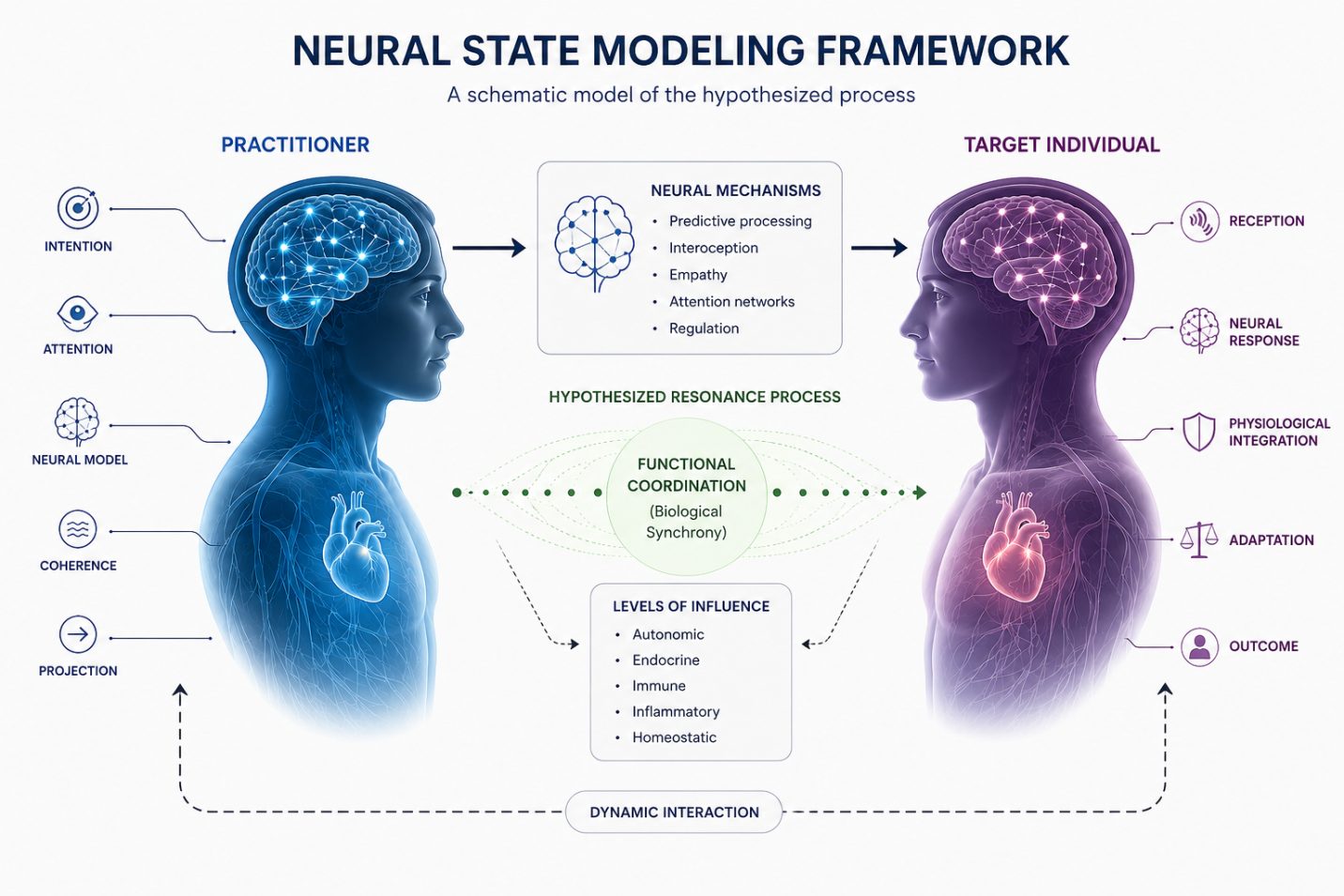
The human brain continuously constructs internal models of both the external world and the body. Contemporary neuroscience increasingly views perception, action, and cognition as processes driven by predictive internal modeling rather than passive sensory processing. Building upon this framework, the present paper proposes the Hypothesis of Conscious Internal Representation and Interpersonal Physiological Modulation, which suggests that conscious and sustained internal modeling of another person's physiological state may, under some conditions, contribute to measurable changes in that person's functional state.
This hypothesis does not claim the existence of any unknown physical force, paranormal phenomenon, or proven therapeutic mechanism. Instead, it presents a conceptual framework intended to stimulate interdisciplinary investigation at the intersection of neuroscience, predictive processing, complex systems theory, interpersonal synchrony, and consciousness research.
The hypothesis originates from a series of repeated observational cases collected over several years. These observations include temporary reductions in pain, improvements in subjective well-being, and transient changes reported by participants following structured sessions of intentional internal physiological modeling performed by the practitioner. While these observations cannot establish causality, they motivate the formulation of testable scientific questions.
The paper distinguishes carefully between empirical observations, theoretical interpretation, and speculative assumptions. Possible conventional explanations—including placebo effects, expectancy, interpersonal regulation, autonomic synchrony, spontaneous recovery, and observational bias—are considered alongside the possibility that additional mechanisms may remain unidentified.
Finally, a research program is proposed, outlining experimental methodologies capable of evaluating the hypothesis using modern neurophysiological techniques such as EEG hyperscanning, heart-rate variability analysis, functional neuroimaging, autonomic monitoring, and randomized controlled designs.
The Hypothesis of Conscious Internal Representation and Interpersonal Physiological Modulation should therefore be regarded not as a conclusion, but as an invitation to scientific investigation.
1.1 Introduction
For centuries, human beings have attempted to understand the relationship between consciousness and the body. Advances in neuroscience have significantly expanded our understanding of perception, cognition, and motor control, yet many aspects of conscious experience remain incompletely understood.
Over the past three decades, one of the most influential developments in cognitive neuroscience has been the emergence of predictive processing, which proposes that the brain continuously constructs internal models of both the external environment and the organism itself. According to this framework, perception is not simply a passive response to incoming sensory information but an active process in which the brain constantly generates predictions and updates them based on incoming evidence.
This perspective has transformed our understanding of perception, learning, movement, and even emotional regulation. The brain is increasingly viewed not as a device that merely reacts to reality, but as an organ that continuously models reality.
The present paper asks a broader question:
Can conscious internal modeling extend beyond self-regulation and contribute, under certain conditions, to measurable changes in another person's physiological state?
This question lies outside the scope of current established neuroscience. Consequently, the hypothesis proposed here should not be interpreted as an established scientific theory or as evidence of a previously unknown biological mechanism.
Instead, it is presented as a research hypothesis motivated by a series of repeated observational cases collected over several years.
These observations involved individuals experiencing diverse conditions, including chronic musculoskeletal pain, inflammatory symptoms, autonomic dysfunction, and severe neurological or oncological diseases. In many cases, participants reported temporary improvements following structured sessions during which the practitioner intentionally maintained a detailed internal representation of the participant's healthy physiological organization.
Numerous conventional explanations remain possible, including placebo responses, expectancy effects, natural fluctuations of disease, spontaneous remission, regression toward the mean, interpersonal emotional regulation, autonomic synchrony, observer bias, and coincidence.
Nevertheless, the repeated occurrence of similar observations across different individuals and conditions raises a question that, in the author's view, deserves systematic scientific investigation rather than immediate dismissal.
Accordingly, this article does not attempt to prove that such interpersonal influence exists.
Its objective is:
to describe the observations that motivated the hypothesis;
to formulate the hypothesis in scientifically cautious language;
to distinguish clearly between established knowledge and speculation;
and to propose experimental approaches through which the hypothesis could eventually be tested.
If, however, reproducible effects are observed under rigorous experimental conditions, neuroscience may gain an opportunity to explore previously unrecognized aspects of human physiological regulation and interpersonal interaction.
For this reason, the Hypothesis of Conscious Internal Representation and Interpersonal Physiological Modulation should be viewed not as a conclusion, but as the beginning of an empirical research program.
2. Theoretical Foundations
The Hypothesis of Conscious Internal Representation and Interpersonal Physiological Modulation is not proposed in isolation. Rather, it builds upon several established concepts from contemporary neuroscience, cognitive science, systems theory, and physiology. While none of these fields currently predicts the phenomenon proposed here, together they provide a conceptual framework within which the hypothesis can be formulated and empirically tested.
2.1 The Brain as a Predictive Modeling System
A growing body of research suggests that the brain functions as a predictive organ rather than a passive processor of sensory information. According to the predictive processing framework, perception arises from the continuous interaction between internally generated predictions and incoming sensory signals.
Instead of constructing reality solely from external input, the brain actively generates models of the world and constantly updates them to minimize prediction errors. These internal models guide perception, movement, attention, emotional responses, and physiological regulation.
Importantly, predictive models are not limited to representations of the external environment. The brain also maintains continuously updated models of the body's internal state, including posture, movement, autonomic regulation, pain, and interoceptive signals.
This capacity for internal physiological modeling provides one of the conceptual starting points for the present hypothesis.
2.2 Internal Models of Other Individuals
Humans possess a remarkable ability to construct internal representations of other people.
During social interaction, the brain continuously predicts another person's intentions, emotions, actions, facial expressions, and likely future behavior. These abilities are supported by multiple neural systems involved in social cognition, action observation, empathy, and mental state attribution.
Current neuroscience interprets these mechanisms as essential for communication and cooperation.
The present hypothesis asks whether this capacity for modeling another individual might, under specific circumstances, become sufficiently stable and detailed to influence physiological regulation.
At present, no established evidence demonstrates that such influence exists.
The question therefore remains entirely open.
2.3 Interpersonal Synchronization
Numerous studies have demonstrated that physiological synchronization naturally occurs between interacting individuals.
Examples include synchronization of:
heart-rate variability,
respiratory rhythms,
emotional responses,
body movements,
and, under some experimental conditions, patterns of neural activity.
Such synchrony has been observed between parents and infants, romantic partners, musicians, therapists and patients, teachers and students, and members of cooperative groups.
These findings indicate that human nervous systems do not function in complete isolation.
Instead, they often become dynamically coordinated during shared interaction.
However, existing research generally interprets synchronization as a consequence of sensory communication rather than as evidence that one individual can intentionally alter another person's physiology.
The Hypothesis of Conscious Internal Representation and Interpersonal Physiological Modulation does not challenge this interpretation.
Instead, it asks whether conscious internal modeling could represent an additional variable worthy of investigation.
2.4 Complex Systems and Emergent Organization
The human organism is a highly complex adaptive system composed of billions of interacting cells organized across multiple hierarchical levels.
Health emerges from the coordinated activity of numerous regulatory networks, including the nervous, endocrine, immune, cardiovascular, and metabolic systems.
Modern systems biology increasingly recognizes that many properties of living organisms cannot be fully understood by studying isolated components.
Instead, physiological stability depends upon dynamic coordination across the entire system.
Within this context, the concept of "resonance" used in this paper should not be interpreted as a physical oscillatory phenomenon in the traditional sense.
Rather, it serves as a conceptual metaphor describing the possibility that two complex biological systems might transiently achieve a state of increased informational or functional coordination.
Whether such coordination can occur intentionally remains unknown.
2.5 From Established Knowledge to Scientific Hypothesis
Taken individually, none of the scientific concepts described above predicts the existence of intentional interpersonal physiological influence.
Collectively, however, they demonstrate that:
the brain continuously constructs internal models;
human physiology is dynamically regulated rather than static;
interpersonal synchronization is a well-documented biological phenomenon;
and complex systems often exhibit emergent behaviors that cannot be predicted solely from their individual components.
These established observations do not validate the Neural Resonance Modeling Hypothesis.
They simply indicate that the hypothesis is not incompatible with current scientific understanding and therefore deserves empirical investigation.
The following sections present the observational evidence that motivated the formulation of this hypothesis before discussing possible experimental approaches capable of evaluating its validity.
3. Observational Background
The Hypothesis of Conscious Internal Representation and Interpersonal Physiological Modulation did not originate from theoretical speculation alone. It emerged gradually from repeated observations collected over several years during individual sessions involving intentional internal physiological modeling.
These observations should not be interpreted as clinical evidence. They were not obtained within controlled experimental settings, lacked randomization and blinding, and were not designed to establish causal relationships. Consequently, they cannot be considered proof of efficacy.
Their scientific value lies solely in motivating the formulation of a hypothesis that may be tested under rigorous experimental conditions.
3.1 Origin of the Observations
The initial observations occurred unexpectedly.
During interactions with individuals experiencing persistent physical symptoms, the practitioner developed a consistent internal procedure. Rather than focusing attention on pain or disease, attention was directed toward constructing and maintaining a coherent internal representation of the person's healthy physiological organization.
This internal process did not involve physical contact, medication, or verbal therapeutic suggestions intended to influence expectations.
Instead, the practitioner maintained sustained concentration on an internally generated model of normal physiological functioning.
After several sessions, some participants reported noticeable improvements in symptoms.
At first, these observations were considered anecdotal coincidences.
However, similar reports continued to emerge over time across individuals presenting with different conditions.
This repetition became the primary motivation for documenting the observations systematically.
3.2 Characteristics of the Internal Modeling Process
The practitioner describes the process as an entirely subjective mental experience.
Attention is first directed toward the individual as a whole, followed by the gradual construction of an internal representation of different organs or physiological systems.
Importantly, these representations are not interpreted as medical diagnoses.
Instead, they consist of subjective mental impressions that may include perceived qualities such as:
rigidity or flexibility,
density or softness,
dryness or hydration,
restricted or free movement,
warmth or coolness,
reduced or increased vitality.
These perceptions should be understood exclusively as elements of the practitioner's internal experience rather than objective observations of biological reality.
After establishing this internal representation, the practitioner intentionally modifies the model toward what is perceived as a physiologically coherent state.
Examples include mentally representing:
increased flexibility of the spine,
restored mobility of joints,
improved circulation,
normalized tissue organization,
reduced neural irritation,
or coordinated function of a specific organ system.
The session continues until the practitioner experiences a subjective sense that the internal model has reached a stable and coherent organization.
3.3 Types of Reported Observations
Across several years, participants reported improvements involving a variety of conditions.
These included, among others:
chronic musculoskeletal pain,
sciatic nerve pain,
inflammatory symptoms,
allergic swelling,
chronic eye irritation,
subjective improvements during Parkinson's disease,
temporary improvements in quality of life during advanced cancer,
recurrent chronic cystitis,
and other functional complaints.
Not all observations involved lasting improvement.
Some effects appeared temporary.
Others gradually diminished.
In certain cases, no observable change was reported.
This variability is itself an important feature of the observations and argues against simplistic interpretations.
3.4 Limitations of the Observational Evidence
The observations described in this paper possess significant methodological limitations.
They lack:
control groups,
blinding,
objective physiological measurements,
standardized outcome assessments,
statistical analysis,
and independent replication.
Furthermore, several conventional explanations remain plausible.
These include placebo responses, expectancy effects, spontaneous recovery, regression toward the mean, emotional support, interpersonal interaction, observer bias, and selective recall.
Consequently, none of the observations presented here should be interpreted as demonstrating the existence of interpersonal physiological influence.
Instead, they should be viewed as preliminary observations that justify further scientific investigation.
3.5 From Observation to Research Question
Scientific progress has often begun with careful observation rather than immediate explanation.
The present work follows the same principle.
The repeated occurrence of subjective improvements does not establish a mechanism.
It does, however, generate a legitimate scientific question:
Can intentional internal modeling of another person's physiological organization produce measurable biological effects under controlled experimental conditions?
At present, no reliable answer exists.
The purpose of this paper is therefore not to provide one, but to formulate the question in a manner that allows it to be investigated objectively using modern scientific methods.
4. Hypothesis of Conscious Internal Representation and Interpersonal Physiological Modulation
The observations described in the previous section do not demonstrate the existence of a previously unknown biological phenomenon. Nevertheless, they provide sufficient motivation to formulate a specific, testable hypothesis.
The Hypothesis of Conscious Internal Representation and Interpersonal Physiological Modulation proposes that, under currently unidentified conditions, sustained conscious internal modeling of another person's physiological organization may contribute to measurable changes in that person's functional state.
Importantly, this hypothesis does not assume the transmission of energy, the existence of paranormal abilities, or any mechanism that contradicts established physical laws.
Rather, it proposes that an as-yet unidentified biological process—if it exists—should be investigated using the same empirical standards applied to any other scientific hypothesis.
4.1 Definition of Hypothesis of Conscious Internal Representation and Interpersonal Physiological Modulation
Within the context of this paper, Neural Physiological State Modeling (NPSM) is defined as:
The intentional and sustained construction of an internal neural representation of another individual's physiologically coherent state, maintained with focused attention over time, with the hypothesis that such modeling may contribute to measurable changes in that individual's biological organization under specific conditions.
This definition deliberately avoids assumptions regarding the underlying mechanism.
The hypothesis concerns the existence of a potentially observable effect, not an explanation of how such an effect might occur.
4.2 Why the Term "Resonance"?
The term resonance is used here in a conceptual rather than a physical sense.
In physics, resonance refers to increased oscillatory response resulting from interaction between compatible frequencies.
The present hypothesis does not claim that the human brain literally operates through such physical resonance during interpersonal interaction.
Instead, the term is employed as a metaphor describing a possible temporary state of increased functional coordination between two complex biological systems.
If future research identifies a different mechanism, the terminology may require revision.
Thus, "resonance" should be regarded as a provisional conceptual label rather than a mechanistic explanation.
4.3 Conscious Internal Modeling
A central assumption of the hypothesis is that conscious attention may stabilize internal neural representations.
Current neuroscience recognizes that attention can influence sensory processing, motor planning, emotional regulation, learning, and autonomic function.
The present hypothesis extends this principle by asking whether sustained attention directed toward an internally generated model of another person's healthy physiological organization might influence biological processes beyond the practitioner's own nervous system.
At present, there is no established evidence supporting this possibility.
It therefore remains a question for future investigation rather than a scientific conclusion.
4.4 Possible Levels of Explanation
Should reproducible effects eventually be demonstrated, several categories of explanation might be considered.
The first possibility is that all observed changes can be fully explained through already known mechanisms, including expectation effects, interpersonal regulation, emotional interaction, behavioral change, and spontaneous physiological variability.
A second possibility is that currently recognized mechanisms explain only part of the observations, while additional neurophysiological processes remain to be identified.
A third possibility is that controlled research ultimately demonstrates no effect beyond existing explanations, leading to rejection of the hypothesis.
At present, all three possibilities remain scientifically acceptable.
The purpose of empirical investigation is precisely to distinguish between them.
4.5 Falsifiability
A scientific hypothesis must be capable of being disproven.
The Neural Resonance Modeling Hypothesis therefore makes no claim of universal validity.
If carefully designed randomized, blinded, and independently replicated studies fail to detect measurable effects beyond placebo, expectancy, or statistical variation, the hypothesis should be modified or rejected.
Likewise, if future evidence consistently supports alternative explanations, those explanations should be preferred.
This commitment to falsifiability distinguishes a scientific hypothesis from a belief system.
The value of the hypothesis lies not in being protected from criticism, but in being open to rigorous testing.
4.6 A Working Scientific Model
At its present stage, Neural Resonance Modeling should be regarded as a working conceptual model.
Its primary purpose is to organize observations, generate precise research questions, and stimulate interdisciplinary collaboration among neuroscientists, psychologists, physiologists, clinicians, and experts in complex systems.
Whether the hypothesis ultimately proves correct or incorrect is less important than whether it encourages careful, transparent, and reproducible scientific investigation.
In this sense, the hypothesis is not presented as an answer.
It is presented as a question that science has not yet fully explored.
5. Discussion of Possible Mechanisms
One of the central challenges facing the Neural Resonance Modeling Hypothesis is the absence of an established biological mechanism capable of explaining the reported observations.
At present, no known neuroscientific theory predicts that one individual can intentionally influence another person's physiological organization solely through sustained internal modeling. Consequently, any proposed mechanism must be regarded as speculative until supported by experimental evidence.
Rather than advocating a single explanation, this paper considers several possible scenarios, ranging from entirely conventional interpretations to the possibility that additional biological mechanisms remain undiscovered.
5.1 Conventional Explanations
The first and most conservative explanation is that all reported observations can be understood through mechanisms already recognized by contemporary science.
These include:
placebo and expectancy effects;
spontaneous remission;
regression toward the mean;
emotional support;
therapeutic interaction;
changes in attention and perception of symptoms;
autonomic regulation associated with relaxation;
observer bias;
selective memory;
coincidence.
Many clinical interventions produce measurable improvements through combinations of these factors. Therefore, any future investigation of Neural Physiological State Modeling must be designed specifically to distinguish its effects from these well-established phenomena.
The burden of proof remains with the hypothesis.
5.2 Interpersonal Physiological Regulation
A second possibility is that the reported observations reflect an extension of already documented forms of interpersonal physiological synchronization.
Research has shown that interacting individuals may exhibit coordinated changes in:
heart rate,
respiratory rhythm,
autonomic nervous system activity,
emotional states,
hormonal responses,
and, in some studies, neural activity.
These findings demonstrate that human physiology can become partially synchronized during social interaction.
However, existing evidence generally attributes such synchronization to sensory communication, shared attention, emotional connection, and behavioral interaction.
Whether intentional internal modeling could amplify or modify these processes remains unknown.
5.3 Unknown Neurophysiological Processes
A third possibility is that current neuroscience does not yet fully describe all forms of large-scale neural coordination.
History demonstrates that biology has repeatedly expanded as new measurement technologies became available.
Numerous physiological mechanisms—including neuroplasticity, mirror neuron systems, interoception, the glymphatic system, and the microbiome's influence on brain function—were poorly understood or entirely unknown until relatively recently.
This historical perspective does not imply that Neural Resonance Modeling is correct.
It simply illustrates that the absence of an accepted mechanism should not automatically prevent empirical investigation.
If reproducible effects are ever demonstrated under rigorous conditions, identifying the underlying mechanism would become an entirely separate scientific challenge.
5.4 Conscious Attention as an Active Variable
One distinctive feature of the present hypothesis is its emphasis on sustained conscious attention.
Current neuroscience already recognizes attention as an active process capable of modifying:
sensory processing,
cortical activity,
learning,
emotional regulation,
pain perception,
and autonomic responses within the individual.
The Neural Resonance Modeling Hypothesis asks whether attention might also function as a stabilizing factor during the construction of detailed internal representations of another person's physiological organization.
Importantly, this proposal concerns attention itself, not mystical intention or supernatural influence.
Whether such attention has any measurable interpersonal consequences remains an open empirical question.
5.5 Multiple Mechanisms May Operate Simultaneously
Scientific phenomena rarely arise from a single cause.
If Neural Physiological State Modeling eventually proves to involve measurable effects, it is likely that several mechanisms would contribute simultaneously.
For example, any observed outcome might involve combinations of:
expectation,
emotional regulation,
autonomic synchrony,
behavioral changes,
neuroplastic adaptation,
interpersonal communication,
and potentially additional mechanisms not yet recognized.
Future research should therefore avoid searching for a single explanatory pathway and instead investigate how multiple biological systems may interact within complex interpersonal contexts.
5.6 The Importance of Remaining Mechanistically Neutral
At the current stage of investigation, proposing a definitive mechanism would be scientifically premature.
The observations described in this paper do not justify strong causal claims.
Instead, they justify careful experimentation.
For this reason, the Neural Resonance Modeling Hypothesis intentionally remains mechanistically neutral.
It proposes only that a phenomenon may exist and that, if reproducible under controlled conditions, its underlying biology should become the subject of systematic investigation.
In science, observations precede explanations.
The primary objective is therefore not to explain the phenomenon before it has been demonstrated, but to determine whether the phenomenon exists at all.
7. Limitations
Every scientific hypothesis is constrained by the quality of the evidence available to support it. The Neural Physiological State Modeling Hypothesis is no exception.
At its current stage of development, the hypothesis should be regarded as highly preliminary. It is based primarily on repeated observational reports rather than controlled experimental evidence. Consequently, numerous alternative explanations remain possible.
Recognizing these limitations is essential for maintaining scientific rigor.
7.1 Absence of Controlled Experimental Evidence
The observations presented in this paper were not obtained through randomized controlled trials.
No placebo control groups were included.
Participants were not randomly assigned.
Neither practitioners nor participants were blinded.
Objective physiological measurements were generally unavailable.
Therefore, the observations cannot establish causal relationships.
They serve only as the empirical motivation for proposing a hypothesis.
7.2 Subjective Outcome Measures
Many reported improvements involved subjective experiences such as:
pain reduction,
increased comfort,
improved mobility,
enhanced well-being,
or perceived improvement in symptoms.
Although such outcomes are clinically meaningful, they remain vulnerable to numerous sources of bias.
Future studies should therefore incorporate objective physiological and clinical measurements whenever possible.
7.3 Placebo and Expectancy Effects
One of the strongest alternative explanations involves placebo-related mechanisms.
Modern neuroscience has demonstrated that expectation alone can significantly influence:
pain perception,
autonomic regulation,
hormonal responses,
emotional state,
immune function,
and motor performance.
The present observations cannot exclude placebo effects.
Consequently, future experiments must specifically control for participant expectations.
7.4 Observer Bias
The practitioner was aware of both the intervention and the participants' conditions.
Such awareness inevitably introduces the possibility of observer bias.
Likewise, participants who anticipate improvement may unintentionally overestimate positive outcomes.
Blinded experimental designs are therefore essential.
7.5 Selection Bias
The cases described in this paper were not collected through systematic recruitment.
Individuals often sought participation because they hoped for improvement.
Such self-selection may influence both reported outcomes and participant characteristics.
Future investigations should recruit participants using predefined inclusion criteria.
7.6 Publication Bias
Positive observations are naturally more memorable than unsuccessful ones.
Without systematic documentation of every session—including those producing no observable change—it becomes impossible to estimate the true frequency of positive outcomes.
Future studies should therefore register all sessions prospectively and report both positive and negative findings.
7.7 Unknown Boundary Conditions
If Neural Resonance Modeling represents a genuine biological phenomenon, it is unlikely to occur under all circumstances.
The conditions necessary for its occurrence remain completely unknown.
Potential variables include:
characteristics of the practitioner,
participant characteristics,
duration of attention,
emotional state,
environmental conditions,
previous interpersonal familiarity,
neurological factors,
physiological state.
Identifying these variables represents an important future research objective.
7.8 Correlation Does Not Imply Causation
Perhaps the most important limitation concerns the distinction between correlation and causation.
Temporal association between an intervention and subsequent improvement does not demonstrate that one caused the other.
Numerous biological processes fluctuate naturally over time.
Without carefully controlled experiments, causal conclusions remain unjustified.
7.9 Scientific Humility
Throughout the history of science, many promising hypotheses have ultimately been rejected after careful investigation.
Others initially considered unlikely have later become accepted following the accumulation of strong evidence.
At present, there is no basis for predicting which path the Neural Resonance Modeling Hypothesis will follow.
Its future should depend entirely upon transparent, reproducible, and independently verified scientific evidence.
For this reason, the hypothesis is presented with deliberate scientific caution.
Its value lies not in claiming certainty, but in encouraging objective investigation of a question that has not yet been systematically explored.
8. Scientific Implications
The ultimate value of a scientific hypothesis is determined not by whether it is initially accepted, but by whether it stimulates meaningful empirical investigation.
The Neural Physiological State Modeling Hypothesis should therefore be evaluated not as a claim of established knowledge, but as a proposal that raises a specific and testable scientific question.
Regardless of its eventual outcome, investigating this question may contribute to several areas of contemporary science.
8.1 Expanding the Study of Consciousness
Despite remarkable progress in neuroscience, consciousness remains one of the least understood phenomena in biology.
Current research has made significant advances in identifying neural correlates of conscious experience, yet many questions remain unresolved, including the precise relationship between subjective awareness, attention, perception, and physiological regulation.
The present hypothesis suggests that conscious attention itself may deserve further investigation—not only as a cognitive process, but also as a potential variable influencing complex biological organization.
Whether this possibility proves correct or not, it encourages new experimental approaches to one of neuroscience's most fundamental questions.
8.2 A Broader Understanding of Human Regulation
Modern physiology increasingly recognizes that the human organism operates as an integrated network rather than as a collection of independent organs.
Neural, endocrine, immune, cardiovascular, and metabolic systems interact continuously to maintain homeostasis.
Research inspired by the Neural Physiological State Modeling Hypothesis could contribute to a deeper understanding of how these regulatory systems respond to focused attention, social interaction, and interpersonal communication.
Even if no unique interpersonal effect exists, such studies may reveal previously unrecognized aspects of human self-regulation.
8.3 Advancing Interpersonal Neuroscience
Interpersonal neuroscience has become an increasingly active field of research.
Studies of therapist–patient interactions, parent–infant relationships, cooperative behavior, and social cognition demonstrate that human nervous systems often become dynamically coordinated during shared experiences.
The present hypothesis extends this area of inquiry by proposing that intentional internal modeling might represent an additional dimension worthy of investigation.
Importantly, this proposal should be examined using the same experimental standards applied throughout neuroscience.
8.4 Improving Experimental Methodology
Attempting to investigate Neural Physiological State Modeling would require highly rigorous experimental designs.
Such studies would likely promote methodological advances in areas including:
hyperscanning technologies;
multimodal physiological recording;
synchronization analysis;
computational modeling of interpersonal dynamics;
statistical approaches for complex biological systems.
Thus, even a negative result could improve research methodology for studying human interaction.
8.5 Clarifying the Limits of Existing Knowledge
Science advances by identifying both what is known and what remains uncertain.
If future experiments demonstrate that all observations described in this paper are fully explained by existing mechanisms, the hypothesis will have served an important purpose by helping define the boundaries of current knowledge more precisely.
Conversely, if reproducible findings remain unexplained, entirely new avenues of investigation may emerge.
In either case, empirical evidence—not theoretical preference—should determine the outcome.
8.6 The Importance of Scientific Neutrality
Throughout scientific history, progress has depended upon maintaining a balance between skepticism and curiosity.
Premature acceptance of extraordinary claims can mislead research.
Premature rejection of unexplored questions can also slow scientific discovery.
The appropriate scientific response is neither belief nor dismissal.
It is careful experimentation.
For this reason, the Hypothesis of Conscious Internal Representation and Interpersonal Physiological Modulation is presented not as a challenge to established neuroscience, but as a possible extension of questions that contemporary neuroscience has not yet fully addressed.
Whether the hypothesis ultimately survives empirical testing or is rejected, its scientific value will depend entirely upon the quality of the evidence obtained.
9. Conclusion
The Neural Resonance Modeling Hypothesis originated not from theoretical speculation, but from a series of repeated observations that raised a scientific question.
At present, these observations do not constitute proof.
They do not establish causality.
They do not demonstrate the existence of an unknown biological mechanism.
What they do provide is sufficient reason to formulate a hypothesis that can be examined using the methods of contemporary science.
Throughout this paper, a clear distinction has been maintained between established scientific knowledge, empirical observations, theoretical interpretation, and speculative assumptions.
This distinction is essential.
Scientific progress depends not only on generating new ideas but also on recognizing the limits of current evidence.
The central proposition of this article is intentionally modest.
It does not claim that conscious internal modeling has been shown to influence another person's physiology.
Instead, it asks whether such a possibility can be investigated objectively under carefully controlled experimental conditions.
If future studies demonstrate that the reported observations can be fully explained by known mechanisms—including placebo effects, interpersonal regulation, spontaneous recovery, or methodological bias—the hypothesis should be revised or rejected.
If, however, reproducible findings emerge that cannot be adequately explained by existing models, further investigation may contribute to a deeper understanding of consciousness, physiological regulation, and human interaction.
In either case, empirical evidence must remain the final authority.
The history of science repeatedly reminds us that genuine progress arises from questions that are investigated with intellectual honesty rather than defended through conviction.
For this reason, the Neural Resonance Modeling Hypothesis is offered not as a conclusion, but as an invitation.
An invitation to test.
An invitation to question.
An invitation to measure.
And, above all, an invitation to allow evidence—not expectation—to determine the future of this idea.
10. Acknowledgments
The author expresses sincere gratitude to all individuals who shared their experiences and allowed their observations to contribute to the development of this hypothesis.
Special appreciation is extended to researchers in neuroscience, cognitive science, physiology, psychology, and systems biology whose work has provided the scientific foundations upon which this conceptual framework has been built.
The author also acknowledges that this hypothesis remains preliminary and hopes that its greatest contribution will be to encourage open, rigorous, and collaborative scientific investigation.
11. References
Allen, M., Levy, A., Parr, T., & Friston, K. J. (2019). In the body's eye: The computational anatomy of interoceptive inference. bioRxiv.
Barrett, L. F. (2017). The theory of constructed emotion: An active inference account of interoception and categorization. Social Cognitive and Affective Neuroscience, 12(12), 1833–1833.
Benedetti, F. (2014). Placebo Effects: Understanding the Mechanisms in Health and Disease (2nd ed.). Oxford University Press.
Clark, A. (2013). Whatever next? Predictive brains, situated agents, and the future of cognitive science. Behavioral and Brain Sciences, 36(3), 181–204.
Clark, A. (2016). Surfing Uncertainty: Prediction, Action, and the Embodied Mind. Oxford University Press.
Craig, A. D. (2009). How do you feel—now? The anterior insula and human awareness. Nature Reviews Neuroscience, 10, 59–70.
Damasio, A. (1999). The Feeling of What Happens: Body and Emotion in the Making of Consciousness. Harcourt.
Damasio, A. (2010). Self Comes to Mind: Constructing the Conscious Brain. Pantheon.
Dehaene, S. (2014). Consciousness and the Brain: Deciphering How the Brain Codes Our Thoughts. Viking.
Friston, K. (2010). The free-energy principle: A unified brain theory? Nature Reviews Neuroscience, 11(2), 127–138.
Friston, K., & Seth, A. K. (2016). Active interoceptive inference and the emotional brain. Philosophical Transactions of the Royal Society B, 371(1708), 20160007.
Gallese, V. (2003). The roots of empathy: The shared manifold hypothesis and the neural basis of intersubjectivity. Psychopathology, 36, 171–180.
Hohwy, J. (2013). The Predictive Mind. Oxford University Press.
Hohwy, J. (2020). New directions in predictive processing. Mind & Language, 35, 209–223.
Melzack, R., & Wall, P. D. (1965). Pain mechanisms: A new theory. Science, 150(3699), 971–979.
Prigogine, I., & Stengers, I. (1984). Order Out of Chaos. Bantam Books.
Rizzolatti, G., & Craighero, L. (2004). The mirror-neuron system. Annual Review of Neuroscience, 27, 169–192.
Seth, A. K. (2013). Interoceptive inference, emotion, and the embodied self. Trends in Cognitive Sciences, 17(11), 565–573.
Singer, T., & Lamm, C. (2009). The social neuroscience of empathy. Annals of the New York Academy of Sciences, 1156, 81–96.
Tononi, G. (2008). Consciousness as integrated information: A provisional manifesto. Biological Bulletin, 215, 216–242.